
When You Don’t Know What to Work On, Go Back to LAPS
Have you ever sat down at your desk and felt completely stuck?
You have a list of things you could be doing.
Write a LinkedIn post.
Create a new offer.
Plan a webinar.
Update your website.
Send an email.
Reach out to potential clients.
There is no shortage of things you could be doing.
But then you look at your calendar and realize it isn't nearly as full as you'd like it to be.
And suddenly you're wondering:
What should I actually be working on?
When that happens, I go back to a simple framework I learned from Daniel Priestley called LAPS.
LAPS stands for:
Leads
Appointments
Presentations
Sales
At first glance, it looks like a simple way to measure your pipeline.
But for me, the real value is that it helps identify where the bottleneck is.
And more importantly, what action I should take next.
L is for Leads
Start at the top of the pipeline.
Are enough of the right people finding you?
If the answer is no, then spending the afternoon tweaking your website or rewriting your sales script probably isn't the highest-value thing you could be doing.
You likely have a lead generation problem.
Ask yourself:
Where are new opportunities coming from?
Am I visible to the people I want to work with?
Am I giving them a reason to pay attention?
Then stop analyzing and start acting.
If you need leads:
✅ Write a post.
✅ Engage in relevant groups.
✅ Reach out to potential partners.
✅ Connect with prospects.
✅ Start conversations.
Don't spend all afternoon researching lead generation.
Go generate leads.
A is for Appointments
Maybe people already know you exist.
They're reading your content.
They're replying to emails.
They're engaging.
The question becomes:
Are those interactions turning into conversations?
Because attention doesn't pay the bills.
Conversations create opportunities.
You can have people liking every post you publish and still have an empty calendar.
If you need appointments:
✅ Send the DM.
✅ Send the follow-up email.
✅ Make the call.
✅ Invite someone for a chat.
✅ Follow up with the person who said, "Let's talk sometime."
You don't need a perfect outreach strategy.
You need conversations.
P is for Presentations
Now you're having conversations.
The next question is whether people clearly understand the value of what you're offering.
Can they see the connection between their problem and your solution?
Can they understand why they should choose you?
Your presentation isn't always a slide deck.
It might be:
A sales call
A proposal
A webinar
A consultation
A demo
The way you explain your offer
If appointments are happening but nobody is moving forward, this is where I'd look.
And again, take action.
✅ Prepare for upcoming meetings.
✅ Refine your message.
✅ Improve your proposal.
✅ Practice your pitch.
✅ Clarify the outcome you're helping people achieve.
The goal isn't to create a prettier presentation.
The goal is to communicate value more clearly.
S is for Sales
Now we get to the final stage.
Are opportunities becoming clients?
If not, there could be several reasons.
Maybe you're talking to the wrong people.
Maybe trust hasn't been established.
Maybe your offer isn't aligned with the problem.
Maybe you're not asking for the sale.
Maybe your follow-up process needs work.
The important thing is not to immediately assume you're bad at sales.
The goal is to identify the real bottleneck.
Then act on it.
If you need sales:
✅ Follow up.
✅ Ask for the decision.
✅ Address objections.
✅ Re-engage stalled opportunities.
✅ Move conversations forward.
Many businesses have opportunities sitting right in front of them.
They simply need attention.
LAPS KPI Check
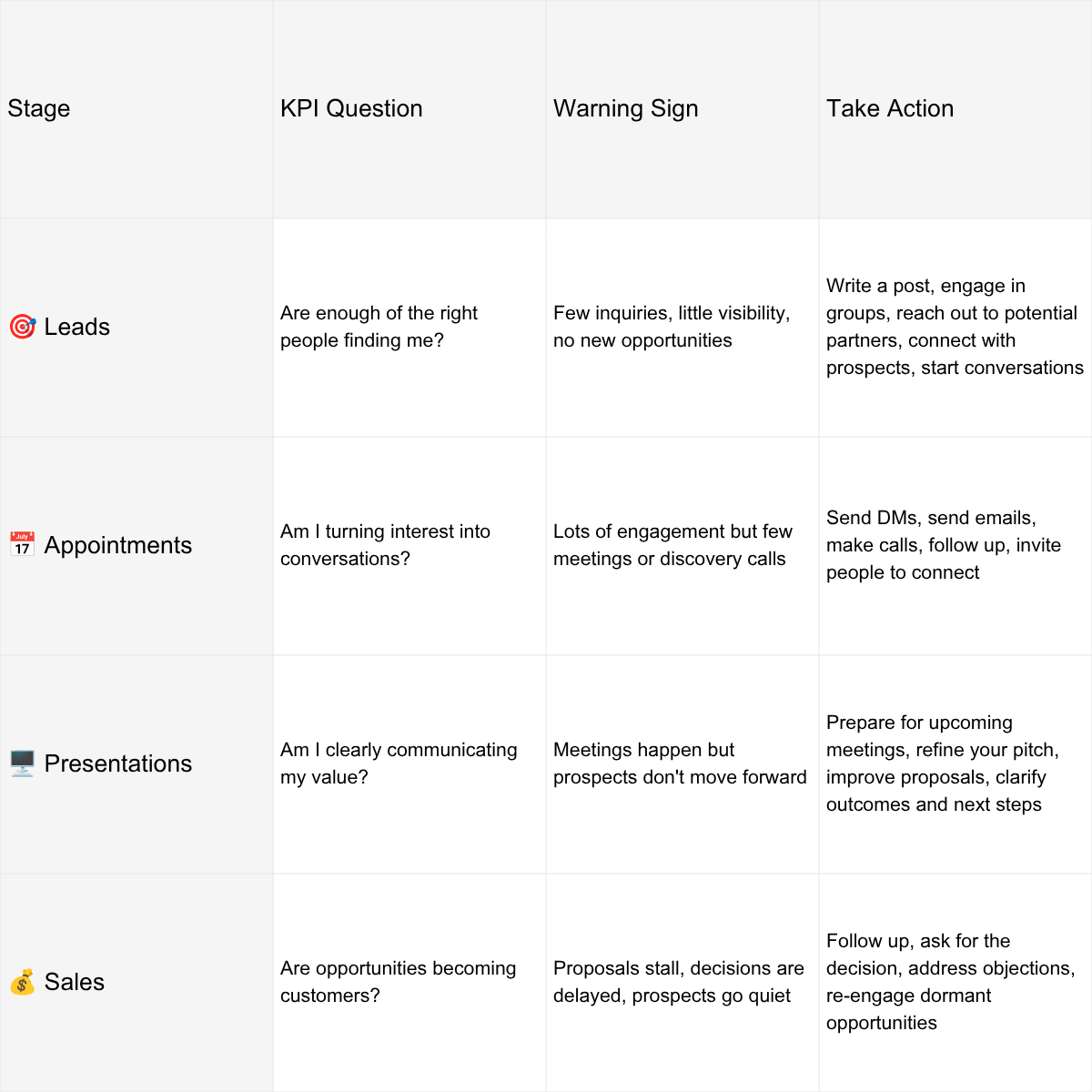
The Real Purpose of LAPS
This is why I like the framework.
When business feels slow, it's easy to stay busy.
Create another offer.
Build another funnel.
Launch another webinar.
Tweak the website.
Design another lead magnet.
Before long, you're working hard...
but you're not necessarily moving the business forward.
LAPS helps you identify where your sales process is.
Do you need more Leads?
More Appointments?
Better Presentations?
More Sales conversations and follow-up?
Once you know the answer, don't disappear into a rabbit hole of planning.
Jump in.
Because business planning can sometimes become another form of procrastination.
You can spend hours researching how to get more leads instead of sending ten messages.
You can spend a day designing the perfect sales funnel instead of calling three people who already expressed interest.
You can keep tweaking your website when what you really need is more conversations.
Sometimes you don't need another strategy.
You need the next action.
So the next time you sit down at your desk and think:
"I have so much to do, but I don't know what I should actually be doing..."
Look at your LAPS.
Find the gap.
And then jump in.
Because LAPS isn't a framework for thinking.
It's a framework for deciding where to take action next.
